My Range Hood's Buttons Were Flashing. A €0.90 Capacitor Fixed It.
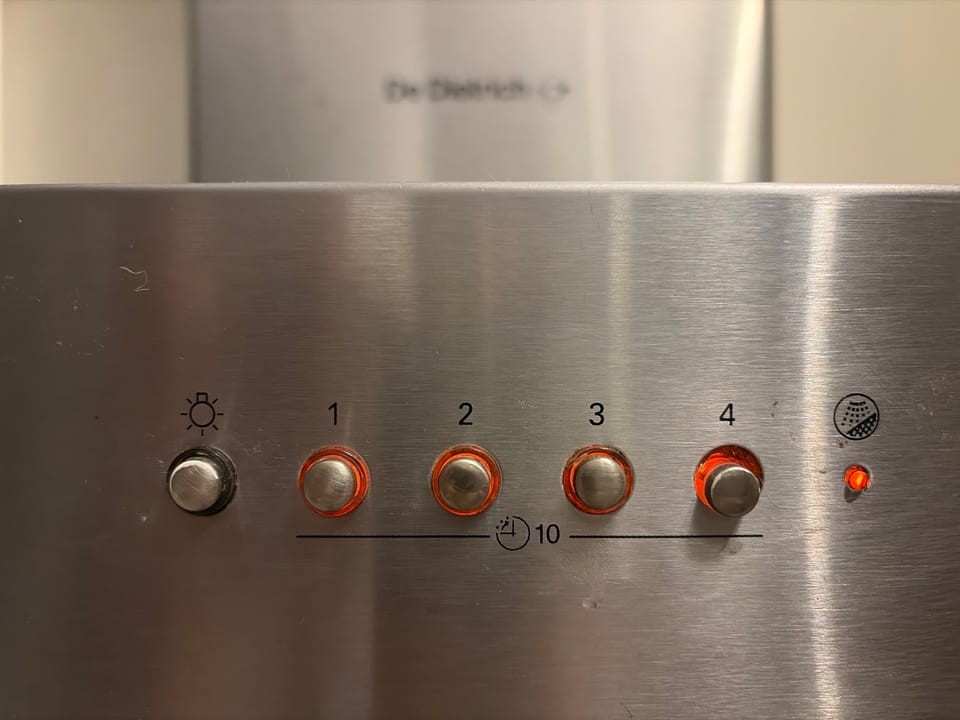
The range hood in my kitchen is a De Dietrich DHD120XE1, a stainless chimney hood with four speed buttons and a light. One evening it stopped working. Pressing any button did nothing useful: the four speed buttons just started blinking very, very fast, all together, and the motor never spun up.
The obvious conclusions were "the electronics are dead" and "call a technician". Neither was true. The fix was one electrolytic capacitor that costs less than a euro.
The symptom, precisely
Details matter here, because this hood has two different blinking behaviours and they mean completely different things.
What I had: the four speed buttons, 1 to 4, flashing rapidly and simultaneously. The hood ignored every press. No suction.
What it is easy to confuse it with: the filter alarm. On the DHD120XE1, the small indicator on the far right of the control panel is a grease filter counter. According to the manual it lights steady red after 30 hours of use (clean the metal filters) and blinks red after 120 hours (clean the metal filters and, in recirculation mode, replace the carbon filters). It is reset with the dedicated "reset filter alarm / timer" control.
That is one LED. It does not stop the hood from running. If it's the speed buttons themselves that are all flashing and the hood won't respond, cleaning filters and resetting the counter will not help. I know because that is where I started.
Owners of the same model and its siblings report variations of the same pattern: all four speed LEDs (plus the saturation LED) flash for a second then go dark, a relay clicks but the motor doesn't start, or the light cuts out the moment the fan is switched on. A widely shared support answer describes it well: the electronics have gone into a protection mode.
Why a capacitor makes buttons blink
The hood has two boards. The one behind the buttons is just the keypad. The one that matters is the power board (part 209 in the De Dietrich exploded view), which takes mains in and drives the motor and the light through relays.
From what owners who have repaired these boards describe, its low-voltage supply is very simple: a small 12 V, 2 VA transformer, a rectifier, a 470 µF / 25 V electrolytic capacitor to smooth the rectified voltage, then a 270 Ω resistor and a 5.6 V zener diode that regulate the rail the microcontroller lives on.
That 470 µF capacitor is the reservoir. Electrolytic capacitors dry out with age and heat, and a hood board sits in a closed box above a motor and a cooktop for fifteen years. As it loses capacitance, the rail is still roughly fine at idle, but the moment you press a button and a relay coil pulls in, the voltage sags. The microcontroller browns out, resets, and the reset shows up as the LEDs flashing. Press again, same thing. It looks like a logic fault. It's a power supply one.
This is also why the "unplug it for a minute" advice doesn't work: there is nothing to reset, the part is physically worn.
The check
The goal is to confirm the capacitor is the culprit before buying anything, and there are two honest ways to do it.
Measure it. A healthy 470 µF capacitor should read somewhere around 450 to 500 µF. Failed ones on this board have been measured at about 70 µF. Anything in the low hundreds or below is dead enough to explain the symptom. Measure it out of circuit, or at least with one leg desoldered, otherwise the rest of the board skews the reading.
The catch: my multimeter has a capacitance range, but it tops out at 200 µF, so it physically cannot read a 470 µF part. That's common on cheap meters, so check the top of your capacitance range before you start. A dedicated capacitance meter that goes higher costs about €20–50; an ESR meter is the proper tool for aging electrolytics, since a capacitor can keep most of its capacitance while its internal resistance has climbed.
What a basic meter can do is catch a dead short: discharge the capacitor, desolder one leg, set the meter to the 200 kΩ resistance range, black probe on the negative (the striped side), red on the positive. A working capacitor charges and the reading climbs towards open circuit. One that stays at zero or a few ohms is shorted. It won't detect a capacitor that has merely lost most of its capacitance, which is the usual failure here.
Or just swap it. The part costs €0.90. When the symptom matches this well, replacing it is a reasonable test, as long as you get the polarity right.
Getting to the board
Turn the hood off at the breaker, not just at the panel. The power board takes 230 V mains.
- Remove the metal grease filters from underneath. You can see where the wiring goes up towards the motor.
- The power board lives in a black plastic box above or next to the motor, with a white ribbon cable and several wires going in.
- If you can't reach it from below, the lower section of the stainless chimney has to come off. It's held by its fixing screws, and often also by paint or a sealant bead against the wall. Don't pull: run a blade along the joint first.
- The box cover is held by two screws, and the board lifts out from the top without removing the motor.
Before unplugging anything, take a photo of the board and every connector. Then find the capacitor: a small cylindrical can marked 470 µF 25 V. Don't confuse it with the big motor run capacitor (around 6 µF, rated for several hundred volts AC) that sits elsewhere in the hood. That one is a separate part with a separate failure mode.
The fix
The replacement I bought at St Quentin Radio, the electronics parts shop next to Gare du Nord in Paris: reference D025, 470 µF / 25 V, radial electrolytic, 105 °C, 10 mm diameter by 12 mm tall, €0.90.
What to get right when buying:
- Same capacitance, 470 µF.
- Same or higher voltage. A 35 V part works electrically, but it was 16 mm tall instead of 12, and space on these boards is tight. 25 V is fine here, since the rail is well below it.
- 105 °C rated, not 85 °C. The board lives in a hot, closed box. This is the cheapest life extension you'll ever buy.
- Radial and polarized, same form factor as the original. Not an axial part, and not a motor capacitor.
Then:
- Note the polarity on the board: the negative leg is under the stripe on the can, and the board silkscreen usually marks it too.
- Desolder the old capacitor.
- Solder the new one in, stripe on the same side. An electrolytic installed backwards will fail, sometimes loudly.
- Reinstall the board, reconnect everything against your photo, close up, power on at the breaker.
The hood came back to life: light and all four speeds working again.
If it doesn't, the same forum threads point at the next suspects on the same supply: the 5.6 V zener and the 270 Ω resistor (measure the zener voltage: no 5.6 V means a problem upstream), and the small transformer (no 12 V AC on its secondary means it's burnt). A full replacement power board exists too, around €25, if you'd rather not solder.
What I'd tell someone with the same hood
- Flashing speed buttons ≠ filter alarm. The filter alarm is one LED. All four speed buttons flashing with a hood that won't run is a power board supply fault until proven otherwise.
- Check your multimeter's capacitance range before relying on it. 200 µF max is common and useless for this part.
- Buy two capacitors. At €0.90 each, a spare costs less than the trip.
- Give the exact model number when you search or ask for help. "My De Dietrich hood blinks" gets you generic filter advice. "DHD120XE1, all speed buttons blinking" gets you straight to the right component.
